An engineer’s overview of the four main liquid filling principles — gravity, isobaric (counter-pressure), vacuum and pressure filling — and which beverages each one suits.
Choosing a filling machine starts with one question: how will the liquid be moved from the product tank into the container? The answer depends on the product’s viscosity, whether it contains dissolved gas, and how sensitive it is to oxygen. There are four main principles.
1. Gravity (atmospheric) filling
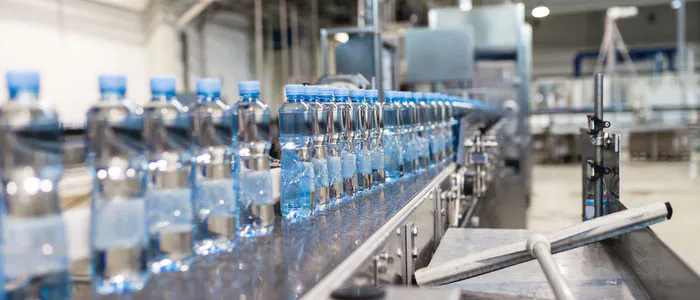
At normal atmospheric pressure, the liquid flows into the container under its own weight. Gravity filling is simple, gentle and accurate for free-flowing, non-carbonated products such as still water, spirits, wine, milk, soy sauce and vinegar. It is the standard principle for purified and mineral water lines.
2. Isobaric (counter-pressure) filling
The container is first pressurised with gas until it reaches the same pressure as the product tank. The liquid then flows in by gravity, with no pressure difference to drive foaming. Isobaric filling is used for carbonated products — beer, soft drinks and sparkling wine — because it minimises CO₂ loss, prevents excessive foaming and keeps the fill level accurate.
A typical isobaric filling cycle has four steps:
- Pressurise the bottle with gas.
- Fill with liquid while gas returns to the tank.
- Stop the liquid flow.
- Release the residual pressure (snift) before the bottle leaves the valve.
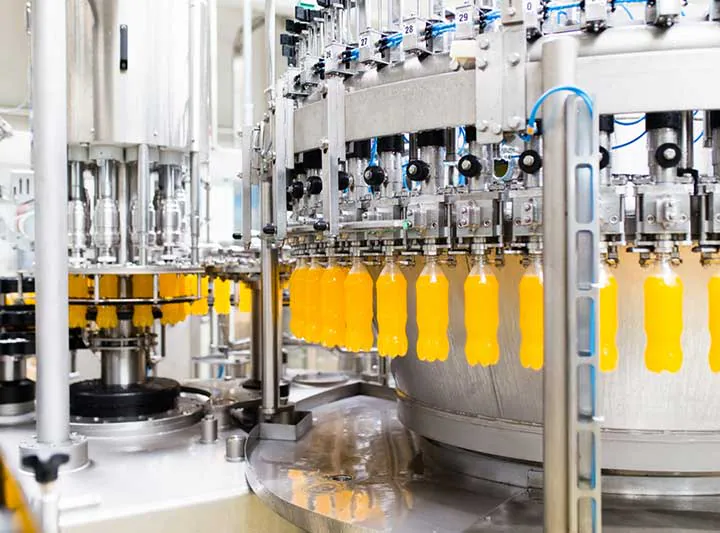
The filling valve combines a liquid valve, return-gas tube, centring bell and exhaust valve. Sensors across the line feed a PLC that controls each step according to the program.
3. Vacuum filling
Filling takes place below atmospheric pressure, in one of two ways:
- Differential-pressure vacuum: the product tank stays at atmospheric pressure and only the container is evacuated, so the liquid flows because of the pressure difference. This is the more common design.
- Gravity vacuum: both the tank and the container are held under the same vacuum, and the liquid flows by gravity. It is mechanically more complex and less widely used.
Vacuum filling suits slightly viscous products such as oil and syrup, and vitamin-rich products such as fruit and vegetable juice, because less contact with air helps protect shelf life. It also limits vapour release when filling hazardous liquids.
4. Pressure filling
A pump or piston mechanically pushes the product into the container. This is the method for thick, viscous products — sauces, pastes and creams. Some soft-drink fillers also use the product’s own pressure to fill quickly without pre-pressurising the bottle; it is faster, but foam can affect fill quality.
Which principle for which product?
| Product | Recommended principle |
| Still, purified and mineral water | Gravity / micro-pressure |
| Juice and tea (hot-fill) | Gravity at elevated temperature |
| Carbonated soft drinks, soda | Isobaric |
| Beer (glass, PET, can) | Isobaric with CO₂ pre-evacuation |
| Edible oil | Weighing, volumetric or vacuum |
| Sauces and pastes | Piston / pressure |
For carbonated drinks the choice is clear: isobaric filling protects carbonation, controls foam and gives accurate fill levels at a reasonable cost — which is why all of our CSD and beer fillers use it.